NEW PUBLICATION

TwinStrand DuplexSeq measuring MRD in AML

TwinStrand’s DuplexSeq™ Mutagenesis Assay is now owned and operated by Scantox. Learn more about DuplexSeq™ Mutagenesis Assays at Scantox.

Read more about the acquisition in the news.

IN VIVO MUTAGENICITY TESTING ​

TwinStrand now offers mutagenicity testing services

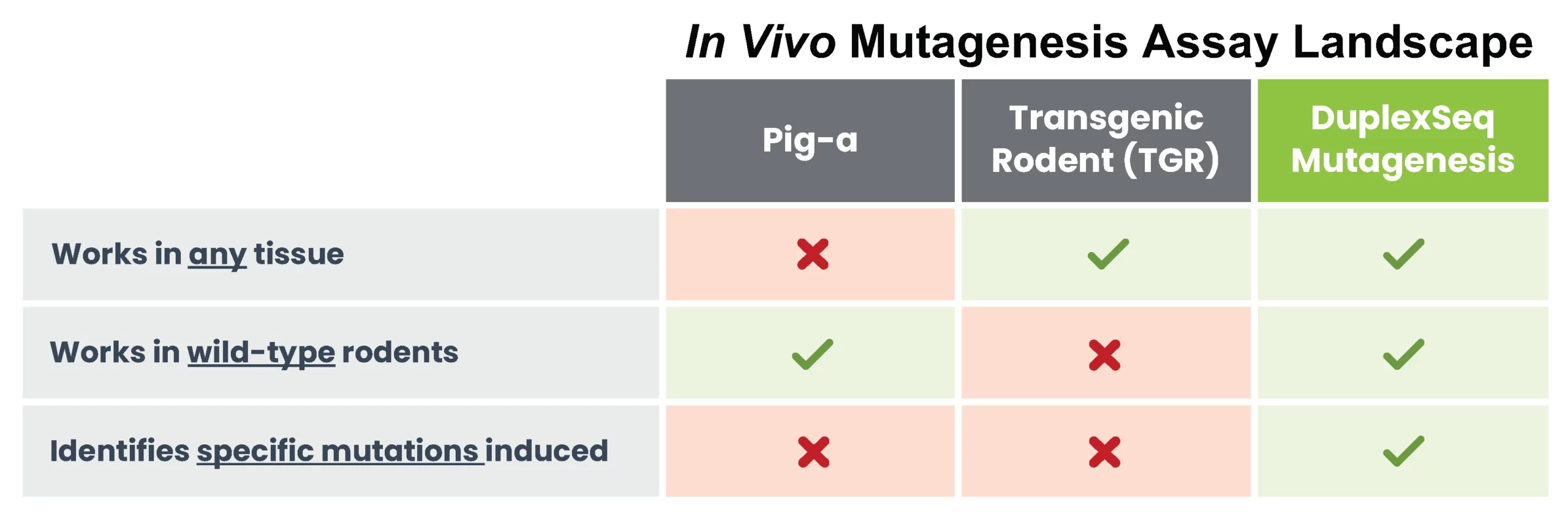
DuplexSeq Assays identify and count the specific types of mutations in your samples, yielding both mutation frequencies and data informing the mutagenic mechanism at play. Run a DuplexSeq Mutagenesis assay on wild-type rodent tissues repurposed from 28-day repeat dose general toxicology studies.​

Integrates seamlessly into any in vivo study workflow​

You can run DuplexSeqTM Mutagenesis Assays on commonly used tissues from transgenic or wild-type rodent studies. TwinStrand does not run animal studies – all in vivo DuplexSeq mutagenicity studies use repurposed tissues generated by partner labs​.

Resources

Numerous in vivo DuplexSeq Mutagenesis studies have been published by our clients and collaborators. Here is a selection of publications from groups that are applying DuplexSeq Mutagenesis assays for in vivo testing, including bridging studies to the transgenic rodent and Pig-a assays.

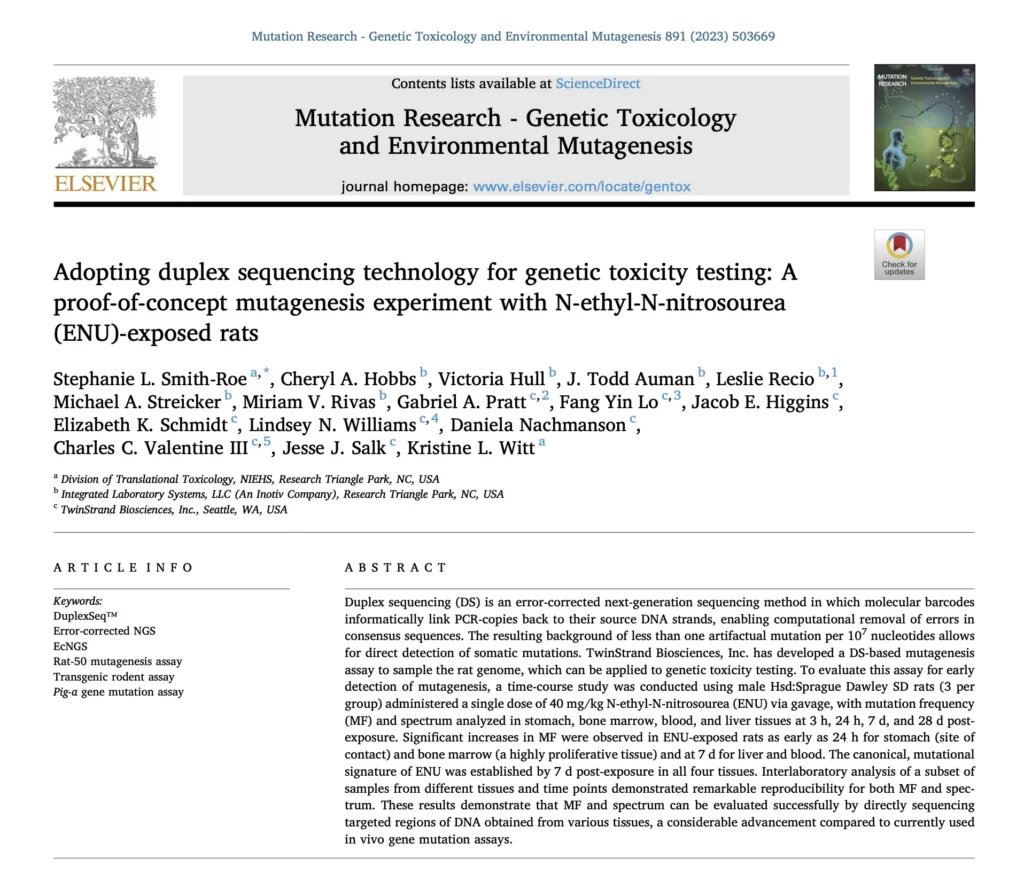
Adopting duplex sequencing technology for genetic toxicity testing: proof-of-concept mutagenesis experiment with N-ethyl-N-nitrosourea (ENU)-exposed rats​

Duplex sequencing (DS) is an error-corrected next-generation sequencing method in which molecular barcodes informatically link PCR-copies back to their source DNA strands, enabling computational removal of errors in consensus sequences. The resulting background of less than one artifactual mutation per 107 nucleotides allows for direct detection of somatic mutations. TwinStrand Biosciences, Inc. has developed a DS-based mutagenesis assay to sample the rat genome, which can be applied to genetic toxicity testing. To evaluate this assay for early detection of mutagenesis, a time-course study was conducted using male Hsd:Sprague Dawley SD rats (3 per group) administered a single dose of 40 mg/kg N-ethyl-N-nitrosourea (ENU) via gavage, with mutation frequency (MF) and spectrum analyzed in stomach, bone marrow, blood, and liver tissues at 3 h, 24 h, 7 d, and 28 d post-exposure. Significant increases in MF were observed in ENU-exposed rats as early as 24 h for stomach (site of contact) and bone marrow (a highly proliferative tissue) and at 7 d for liver and blood. The canonical, mutational signature of ENU was established by 7 d post-exposure in all four tissues. Interlaboratory analysis of a subset of samples from different tissues and time points demonstrated remarkable reproducibility for both MF and spec-trum. These results demonstrate that MF and spectrum can be evaluated successfully by directly sequencing targeted regions of DNA obtained from various tissues, a considerable advancement compared to currently used in vivo gene mutation assays.

AUTHORS

Stephanie L. Smith-Roe a, Cheryl A. Hobbs b, Victoria Hull b, J. Todd Auman b, Leslie Recio b 1, Michael A. Streicker b, Miriam V. Rivas b, Gabriel A. Pratt c 2, Fang Yin Lo c 3, Jacob E. Higgins c, Elizabeth K. Schmidt c, Lindsey N. Williams c 4, Daniela Nachmanson c, Charles C. Valentine III c 5, Jesse J. Salk c, Kristine L. Witt

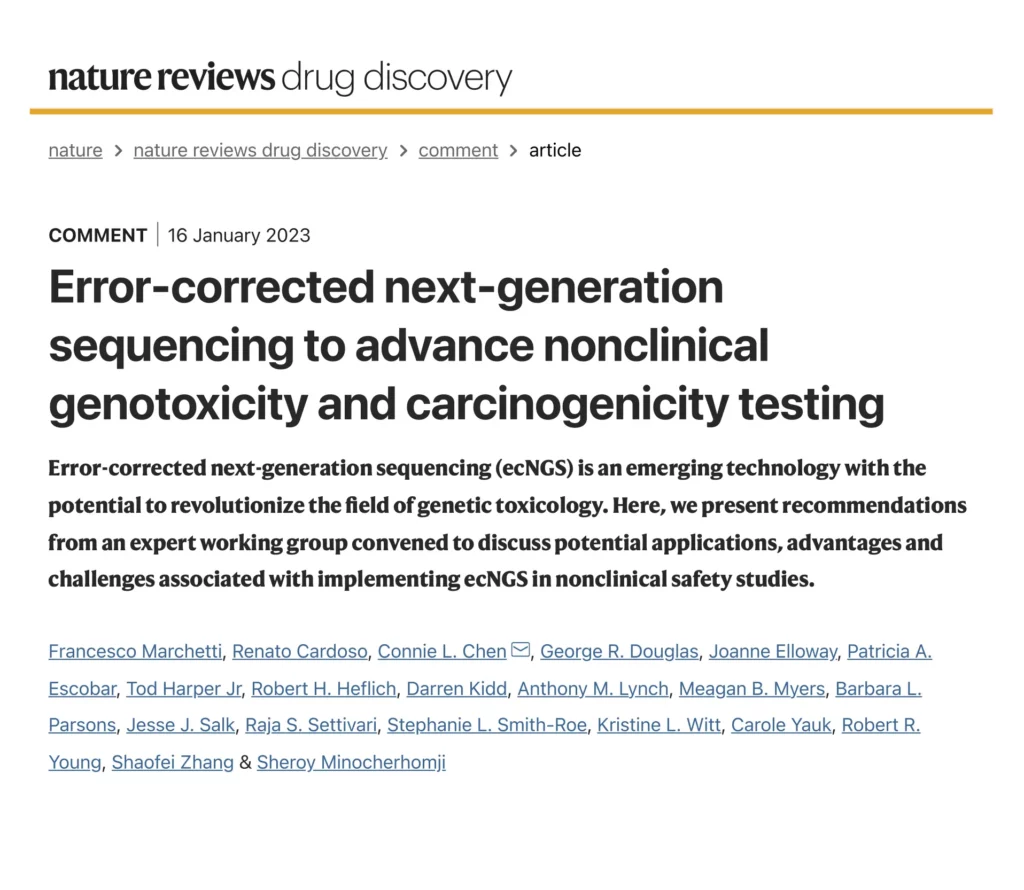
Error-corrected next-generation sequencing to advance nonclinical genotoxicity and carcinogenicity testing

Nature Reviews Drug Discovery, vol. 22, no. 3, Mar. 2023, pp. 165–66.
Error-corrected next-generation sequencing to advance nonclinical genotoxicity and carcinogenicity testing

Error-corrected next-generation sequencing (ecNGS) is an emerging technology with the potential to revolutionize the field of genetic toxicology. Here, we present recommendations from an expert working group convened to discuss potential applications, advantages and challenges associated with implementing ecNGS in nonclinical safety studies.

AUTHORS

Francesco Marchetti, Renato Cardoso, Connie L. Chen, George R. Douglas, Joanne Elloway, Patricia A. Escobar, Tod Harper Jr, Robert H. Heflich, Darren Kidd, Anthony M. Lynch, Meagan B. Myers, Barbara L. Parsons, Jesse J. Salk, Raja S. Settivari, Stephanie L. Smith-Roe, Kristine L. Witt, Carole Yauk, Robert R. Young, Shaofei Zhang & Sheroy Minocherhomji